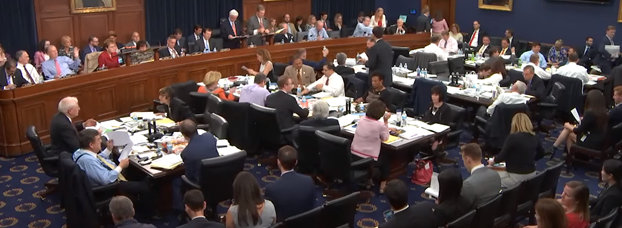
After the markup and release of appropriations bills from the House and Senate Appropriations Committees, the Northeast-Midwest Institute prepares fact sheets highlighting their impacts on key regional programs. Listed below are the fact sheets from the 2024 and 2026 fiscal years.
Also below are tables displaying numbers from different stages in the appropriations process, compared with historical funding levels for key regional programs. These numbers will be updated as bills pass their respective chambers.
FY 2027 Appropriations Fact Sheets
House Appropriations Bills Fact Sheet | June 11th, 2026
FY 2026 Appropriations Fact Sheets
Senate Appropriations Bills Fact Sheet | September 10th, 2025
House Appropriations Bills Fact Sheet | September 10th, 2025
FY 2026 Appropriations Report | January 20th, 2026
FY 2024 Appropriations Fact Sheets
FY 2024 Appropriations Report | March 25th, 2024
Historical Funding for Key Regional Programs
| Commerce, Justice, Science, and Related Agencies (figures in millions of dollars) | FY22 | FY23 | FY24 | FY 26 President’s Request | FY 26 Minibus |
|---|---|---|---|---|---|
| NOAA’s Ocean Laboratory and Cooperative Institutes account1 | 37.1 | 39.5 | 39.5 | 0 | 40 |
| Coastal Zone Management Grants | 78.5 | 81.5 | 81.5 | 0 | 81.5 |
| National Sea Grant College Program | 75 | 80 | 80 | 0 | 80 |
| Sea Grant Aquaculture Research | 13 | 14 | 14 | 0 | 14 |
| NOAA’s IOOS Regional Observations account2 | 40 | 42.5 | 42.5 | 0 | 47.5 |
1 This NOAA account includes funding for the Great Lakes Environmental Research Laboratory (GLERL)
2 This NOAA account includes funding for the Great Lakes Observing System (GLOS)
| Energy and Water Development, and Related Agencies (figures in millions of dollars) | FY23 | FY24 | FY 26 President’s Request | FY 26 Minibus |
|---|---|---|---|---|
| Brandon Road Lock and Dam Aquatic Nuisance Species Barrier | 47.881 | 0 | 28 | 28 |
| Chicago Sanitary and Ship Canal | 14.33 | 13.75 | 12.9 | 12.9 |
| New Soo Lock, Sault Ste. Marie, MI | N/A | 257.4 | 176.6 | 176.6 |
| Great Lakes Coastal Resiliency Study | 3 | 3 | N/A | N/A |
| Great Lakes Authority | N/A | 5 | 0 | 5 |
3 An additional $225.84 was included for this project through the Infrastructure Investment and Jobs Act (IIJA)
| Interior, Environment, and Related Agencies (figures in millions of dollars) | FY24 | FY 26 President’s Request | FY 26 House Bill | FY 26 Senate Bill |
|---|---|---|---|---|
| Great Lakes Restoration Initiative | 368 | 368 | 368 | 368 |
| BEACH Grants | 9.75 | 0 | 9.8 | 9.75 |
| Clean Water State Revolving Fund | 1639 | 155 | 1208 | 1639 |
| Drinking Water State Revolving Fund | 1126 | 150 | 894.7 | 1126 |
| USFWS Invasive Carp programs | 31 | N/A | 26 | 28 |
| Great Lakes Fish and Wildlife Restoration program | 3 | N/A | 3 | 3 |
| USGS National Cooperative Geologic Mapping Program | 43.5 | N/A | 43.5 | 43.5 |
| USGS Invasive Carp Research | 11 | N/A | 11 | 11 |
| Lake Champlain Sea Lamprey program | 0.8 | N/A | 0.8 | 0.8 |
| State, Foreign Operations, and Related Programs (figures in millions of dollars) | FY23 | FY24 | FY 26 President’s Request | FY 26 House Bill |
|---|---|---|---|---|
| Great Lakes Fishery Commission | 50 | 50 | 39 | 54.8 |
| International Joint Commission | 10.9 | 10.9 | 10.9 | 10.9 |
| Transportation, Housing and Urban Development, and Related Agencies (figures in millions of dollars) | FY22 | FY23 | FY24 | FY 26 President’s Request | FY 26 House Bill | FY 26 Senate Bill |
|---|---|---|---|---|---|---|
| Great Lakes St. Lawrence Seaway Development Corporation (GLS) | 38 | 38.5 | 40.29 | 41 | 38.1 | 40.6 |
| MARAD’s Port Infrastructure Development Program | 234.3 | 212.2 | 120.5 | 550 | 123.5 | 96.5 |